
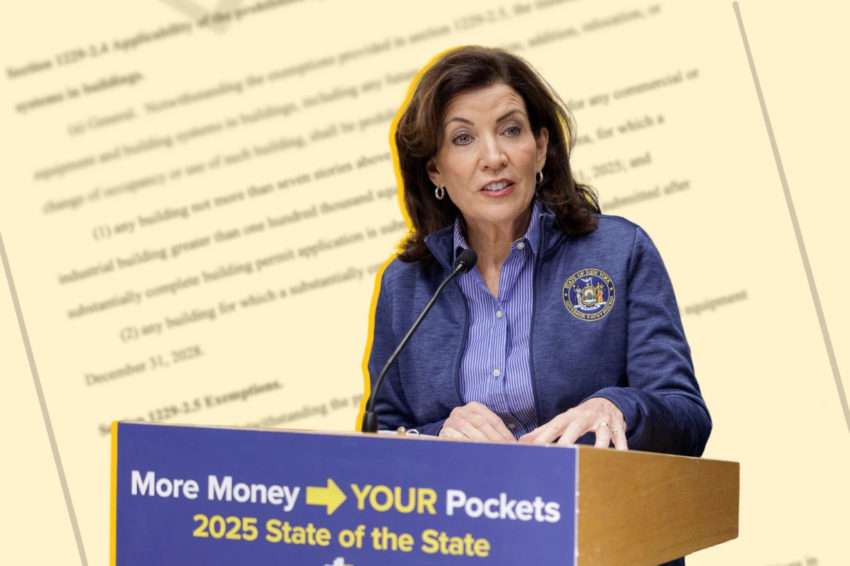
New York Gov. Kathy Hochul is under fire from environmental advocates and progressive Democrats after her administration postponed a landmark law that would ban natural gas in most newly constructed buildings. The All-Electric Buildings Act was set to take effect January 1.
Hochul’s office says the move is merely an extension and that she remains committed to the law. But critics say the delay signals a retreat from major climate goals — and arrives alongside other decisions that have frustrated environmentalists. The administration recently approved a natural gas pipeline that had long been stalled, and it green-lit a power plant in the Finger Lakes that is prepared to operate for crypto-mining.
Lt. Gov. Antonio Delgado, who is challenging Hochul in the Democratic primary, has emerged as one of the sharpest critics, calling the actions “a shame” and accusing the governor of backtracking on climate commitments.
Lisa Marshall, advocacy and organizing director at New Yorkers for Clean Power and a leader of the Renewable Heat Now campaign, said the delay undercuts years of climate progress.
“Well, you know how they say when you’re in a hole, the first thing to do is stop digging. That’s what the All-Electric Building Act does,” Marshall said. “These are just better, healthier, safer buildings. It’s a win for everybody, and it’s an extreme disappointment to have Governor Hochul delaying this law today.”
Marshall argued Hochul is wavering on climate commitments. “She really seems to be going back and forth on these common-sense climate measures,” she said. “She is not doing this because she supports the law. She is doing this because she is not brave enough to stand by her own policies and bring the case to the people of New York.”
Marshall said the delay will allow developers to continue “building systems that are sort of like an anachronism in these brand-new buildings.”
“This is really giving an out to the corporate developers,” she said. “They should be state-of-the-art, safe, and healthy, and instead they’re going to be able to be hooked to the gas system for who knows how much longer.”
She also emphasized the health stakes, noting high rates of asthma and heart disease linked to fossil-fuel combustion in homes. “If you have the gas stove and a gas furnace, it’s like a tailpipe in your kitchen,” she said. “You’re breathing nitrogen oxides and particulates that are not healthy and not safe.”
Marshall disputed claims that electrifying new buildings would overwhelm the grid. “That is completely false,” she said. “The all-electric building law has an exemption. And we have plenty of headroom in the winter. There’s just not that many new buildings being built in New York.”
She said cost concerns are also exaggerated. “It’s another scare tactic,” Marshall said. “We have several studies showing the costs are better if you build all-electric.”
Marshall said advocates are now pressing Hochul to sign another major climate measure — the repeal of the state’s “100-foot rule,” which shifts the cost of new gas hookups onto all ratepayers. “The annual cost of hooking up buildings to the gas system was almost $600 million a year,” she said. “People have been noticing those bills going up and up.”
Thousands of Renewable Heat Now supporters plan to rally in December, she said, delivering postcards and urging Hochul to reverse course. “We have a very positive, forward-looking, joyful movement,” Marshall said. “We’re registering our very deep disappointment and sadness over the loss of what is really a common-sense, win-win law.”
Photo: Office of Governor Kathy Hochul; Illustration: New York Focus
Multi-level buildings might be in the forefront of this bill, not single family homes or small brick and mortar businesses. This bill makes no financial sense to a family of 5. A commercial landlord would definitely benefit from going all electric. This has no options for smaller constructions.