Editor‘s Note: After this story was published, Steven Boynton said DSS provided him with a shower chair and toilet seat riser for extra mobility support on Nov. 26. He’s still waiting on a shower curtain and microwave for his room.
He also clarified that his November 2025 SNAP payment was issued as a lump sum with his October payment, but he was unaware of the deposit until DSS notified him after the story was published. A previous version of the article incorrectly stated he did not receive his payment yet.
—
Jen Duncan wears five jackets and three layers of pants to stay warm in November. As freezing rain taps against the roof of her tent, she says her brain fog and muscle fatigue has worsened.
“I’m weak. It hurts. All my joints [are] burning now. Burning joint pain through the roof,” she said.
Duncan has a chemical brain condition called solvent-induced toxic encephalopathy. When she’s around chemicals like cleaners, traffic fumes, and mold buildup, she loses motor, cognitive, and neurological function.
“The brain starts swelling. The oxygen drops. I lose muscle control. I have convulsions, and eventually, I can lose speech,” said Duncan.
Duncan was homeless for months before being placed at the Knights Inn in Liberty in August. The hotel on Route 52 is one of several hotels Sullivan County contracts to temporarily house more than 300 unhoused adults and children, according to a November Sullivan County health report.
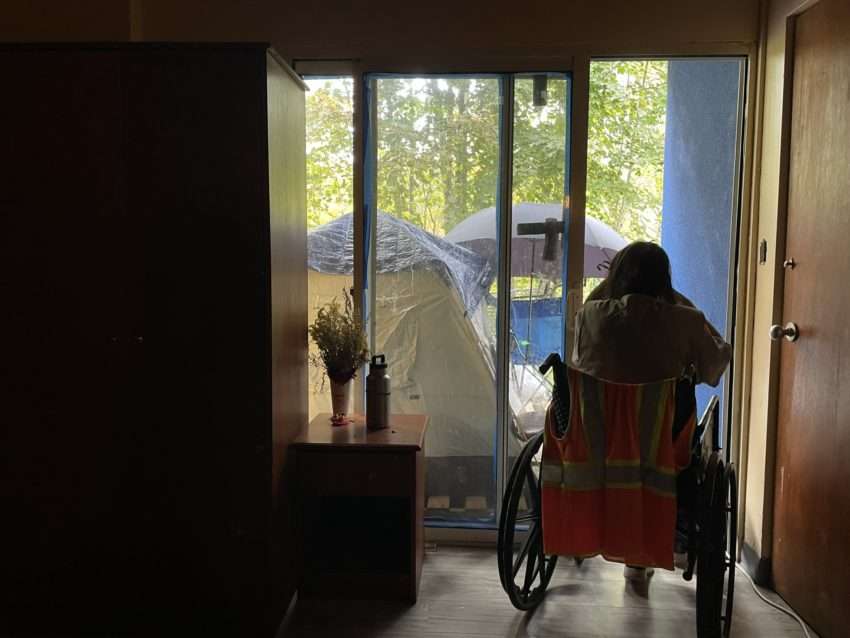
But she says her room is not wheelchair accessible and has toxic chemicals like mold and paint that exacerbate her disability. Since moving to the Knights Inn, Duncan has been living outside the motel until Sullivan County’s Department of Social Services (DSS) can provide her a medically accessible room, she says.
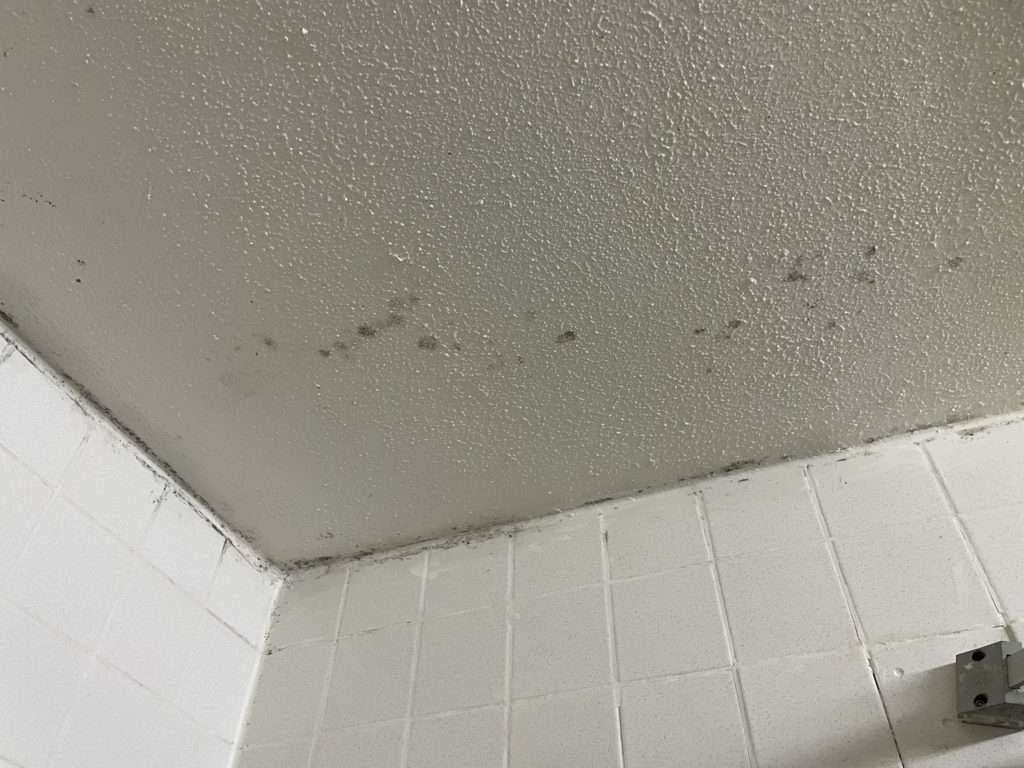
In her bedroom, there are mold spots on the bathroom ceiling, water damage, and peeling paint – all hazardous materials that aggravate her symptoms, says Duncan.
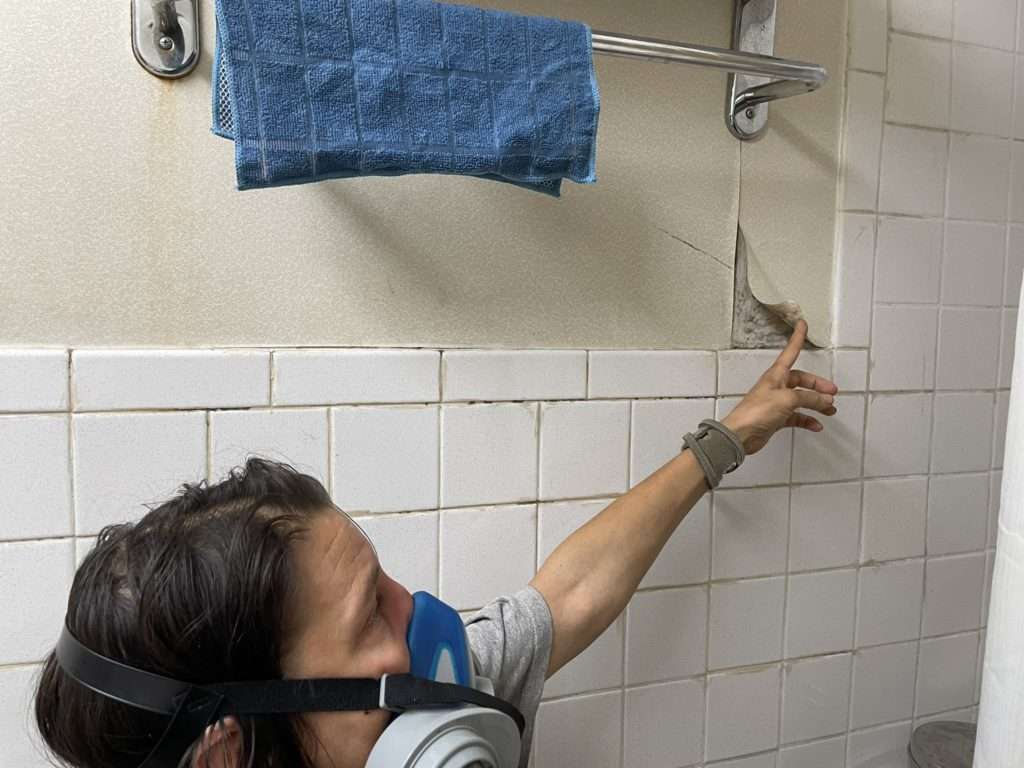
Her black wheelchair doesn’t fit through the bathroom’s narrow door, so she lunges into the bathroom when she needs to use the toilet. The bathroom also doesn’t have a grab bar or shower chair for her to use for extra motor stability. Duncan says she hasn’t been able to safely bathe in her bathroom in months.
Hotel-for-housing placements have increasingly become New York’s go-to system to shelter homeless families despite offering no wraparound support services. A New York Focus investigation found that statewide spending on hotels more than tripled from 2018 to 2024, far exceeding spending on family shelters and transitional housing.
For more than 15 years, Sullivan County has used a patchwork system of hotels and motels for emergency housing across Liberty and Monticello. In 2024, the county spent nearly $3.5 million on hotel vendor contracts. But some disabled residents say that the accommodation provided is both inaccessible and dangerous to their health.
Sullivan County Health and Human Services Commissioner John Liddle told Radio Catskill that DSS could not speak to the details of any individual cases out of respect for client privacy and confidentiality.
“Finding accessible housing for persons with disabilities is often challenging, but we are very proud of the work we do to ensure no one from Sullivan County is forced to live in an unsheltered environment,” said Liddle.
He added that Sullivan County performs detailed inspections of hotels every six months as required by state regulations and that DSS staff check in with clients weekly and report any client concerns to hotel operators to address.
“There are rare occasions where an ADA-accessible room is not immediately available, and it is always our immediate priority to ensure the safety of clients by first getting them out of an unsheltered environment and then getting them to a more appropriate room for their needs as soon as possible thereafter,” said Liddle.
Duncan says she’s been in contact with Liddle and DSS to complete necessary housing paperwork and create a non-toxic housing environment, but progress has been challenging – and slow.
Commissioner Liddle has publicly criticized the limitations of the county’s hotel-for-housing model. During a Sullivan County legislative meeting in May, he advocated in support of a new gateway housing center to reduce the county’s reliance on hotels and motels. Earlier this year, Sullivan County legislators failed to agree on a site location to move the project forward.
“Sullivan County has been told for many years that we need to be rethinking, that we need to not be using hotels. Unfortunately, I don’t have that option right now because we have so many people that we are housing, working with eight different hotels across the county,” said Liddle during the May 8 meeting.
READ: Sullivan County Legislature Scrambles for a New Housing Shelter Location
Dr. Sharon McLennon Wier, executive director of disability advocacy nonprofit Center for Independence of the Disabled New York, said that temporary housing needs to be accessible, regardless of if it’s a shelter or a hotel.
“What’s the point of getting a place if it can’t accommodate your needs?” said Wier. Her organization has served many disabled New Yorkers experiencing homelessness who need a variety of accommodations, like requesting a reader or needing a specific diet.
She says it’s the responsibility of both county agencies and hotel operators to fulfill the government contract they agreed to to provide safe, accessible accommodations.
“These private owned businesses also need to be held accountable,” said Wier. “It seems as if you are serving a group of participants that are poor… the level of service in housing is very deficient.”
Radio Catskill reached out to Sonesta Hotels and Resorts, the franchising corporation that owns Knights Inn hotels, for comment but did not hear back before the publication of this article.
A call for accountability
Steven Robert Boynton is also homeless and lives at the Knights Inn. He started using a wheelchair in October, he says, after getting into a fight with a former roommate.
“I got stabbed in this knee by accident, and I just can’t walk. I can’t apply pressure to this leg,” said Boynton.
To access his room, Boynton struggles to roll his wheelchair through the door entrance, where there’s a loose carpet cut that is difficult to maneuver his wheelchair over.
Like Duncan, he also can’t fit his wheelchair through the narrow bathroom door. Boynton says he has to crawl over and hang onto the sink base before sliding onto the toilet when he needs to use it.
Boynton was also waiting to hear back about his November SNAP payment following the end of the government shutdown. After this story was originally published, DSS notified him that his November 2025 SNAP payment was already issued as a lump sum with his October payment.
He said he had tried contacting his caseworker about his public benefit and accessibility concerns but “get no calls back.”
Other rooms that Radio Catskill observed at the Knights Inn had missing light bulbs, mold growth, and exposed electric wiring. Boynton and Duncan say more accountability is needed from Sullivan County to provide accessible housing.
“These people do not have regulations [for] this place. They need to be monitored more by the government. I was serving in the Army for two to three years and never had problems like this,” said Boynton.
As colder temperatures approach, Duncan remains in her tent outside the Knights Inn just steps away from the highway and under several windows with cannabis and cigarette smoke. Her bedding is wet from the rain and snowfall the last few weeks.
“With food, fresh air, aide, [and] meds, [this was] preventable,” said Duncan.
Image: Jen Duncan navigates her room at the Knights Inn in Liberty, N.Y. in September 2025 (Photo Credit: Kimberly Izar)