

With the federal government shutdown entering a third week, it might seem as if Americans are more divided than ever before.
But a new study shows that on issues of healthcare, housing, and access to good paying jobs, Americans across all political affiliations are in resounding agreement.
The Finding Community through Common Ground Study was published by the Robert Wood Johnson Foundation (RWJF) at the end of September. A New Jersey-based non-profit, RWJF is guided by the mission that healthcare is a right to all, not a privilege to some.
First launched in focus groups conducted by PerryUndem in April 2025 and then in an online survey funded by RWJF between June and July 2025, the study is based on the answers of over 2000 adults across the United States. While there was an even split across political affiliations, yearly income brackets, age, and gender, the topline results showed the highest number of answers from those identified as living in the South, white, and currently employed.
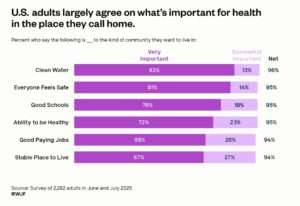
Still, the results show that among adults nationwide, most prioritize clean drinking water, public safety for all, education, ability to be healthy, and access to affordable housing in their communities. In addition, most Americans recognize the role that wealth plays in securing personal security, with the largest number of people saying that income allows a person to thrive and be healthy.
As Lauren Smith M.D., Vice President of Strategic Portfolio at RWJF sees it, these results are not surprising but rather confirm shared values across the country, even with the constant display of political conflict.
“There is a constant stream of divisive politics and social media algorithms that seek to accentuate or intensify divisions and that makes it seem like there is no common ground and that our shared challenges are impossible to solve,” said Smith. “But we really need to react against that false idea, because there is so much among us in terms of our shared priorities and what our shared challenges are, and a commitment and a desire to want to solve them together.”
While the study showed an overwhelming share of values across the spectrum, the main division in the data came in what level of government people feel these problems should be addressed at.
In the survey conducted over the summer, 24% of respondents said that the federal government was responsible to fix an issue like housing, 35% said that it should fall to the state, and 33% said that it should fall to local governments.
Even with this divide, Smith said that these numbers show a fundamental belief in the population in the value of a government body to work with the people to address problems.
“ We don’t agree on everything and we won’t. But this narrative of division really overshadows our shared priorities and values, and I think it harms our health, our wellbeing, and ultimately our democracy,” said Smith. “I think when people have the opportunity to listen to each other, they have the opportunity to identify these areas of common ground.”
Listen for more. To read more about the study, visit rwjf.org/commonground
Image: Illustration “Change Happens When Diverse Voices Shape Narratives” (Credit: RWJF.org)