X-Snow is a NASA-supported snow science project to increase the number of available snow measurements in the Catskill and Adirondacks regions. Project scientist Dr. Marco Tedesco says that to do so, he’ll need the help of local residents.
He says that snowflakes, big and small, can tell you a lot about upstate New York’s terrain.
“When you look at snowflakes on the ground, they can tell you the story of the atmosphere through which they go through,” said Tedesco, a Lamont Research Professor at the Lamont-Doherty Earth Observatory of Columbia University. “The shape of the snowflakes… tells you exactly what’s the temperature [and] humidity of the atmosphere at the snowfalls.”
Snow is a necessary element to the Catskills’ reservoirs and drinking water supply but also for economic and agricultural reasons. “Snow can insulate thermally, protect from freezing vegetation, and can reflect a lot of radiation from the sun back in the sky, keeping things cooler and basically impacting the way the temperature and the weather evolves around,” he adds.
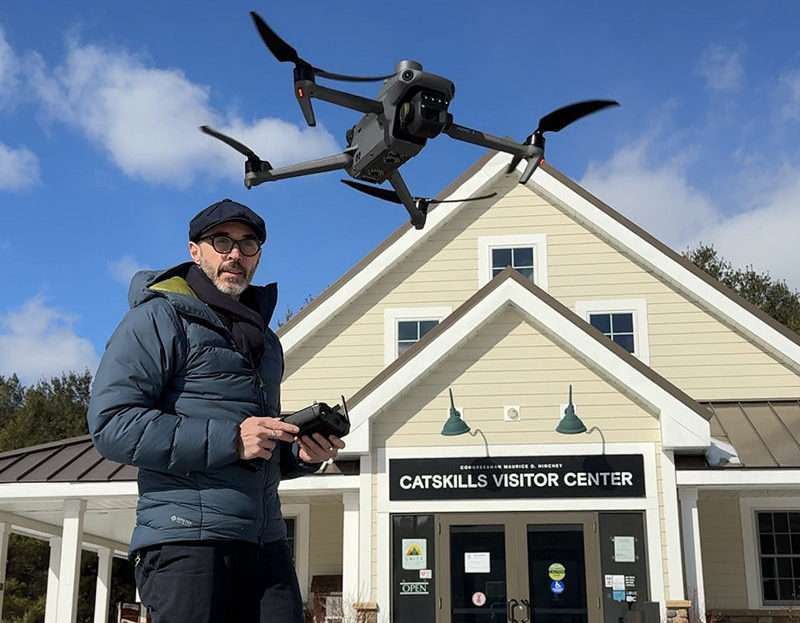
The X-Snow research team hosted an introductory training at the Catskills Visitor Center in Mount Temper on Nov. 8, where attendees learned how to view drone footage and record snow data.
Snow science has largely been concentrated on the West Coast due to the region’s more persistent snowpack and investment interest, Tedesco says, while little research has been completed on East Coast snow.
Community engagement is the backbone of the X-Snow initiative. “Everyone has the superpower to give us the information and collect the data,” said Tedesco.
Residents can help with data collection in several ways, from measuring snow depth with georeferenced photos to collecting detailed snowflake images.
He says just a few minutes measuring snow data in your backyard can make a big difference in understanding why snow is disappearing sooner and coming down harder in shorter bursts.
“Again, this is not just to combat climate change. It’s not something that is either political or science versus non-science. This also has incredibly important reverberations for the economy, for the people who live in the areas, and that’s their home,” said Tedesco. “I think you have the right to know what’s happening as much as you can [in] the place where you live, and that’s what we’re trying to do.”Remove featured image
Image: Dr. Marco Tedesco launches a drone to survey the snow outside the Catskills Visitor Center. (Credit: Brent LeRash)